
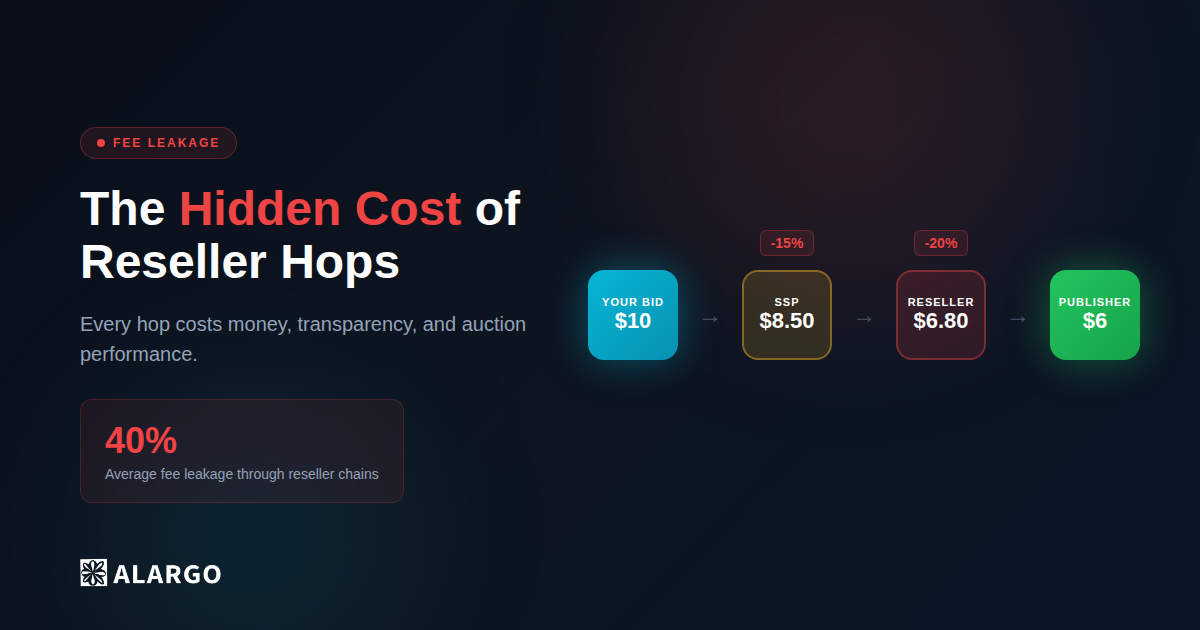
You bid $10 CPM. The publisher sees $6. Where did the other $4 go?
In programmatic advertising, the path between your DSP and the publisher is rarely direct. Your bid passes through SSPs, exchanges, and often resellers — each taking a cut before the money reaches the actual inventory owner.
One hop might cost you 10-15%. Two hops? Now you're losing 25-30%. Three or more? You're lighting money on fire.
What Is a Reseller Hop?
When a publisher makes inventory available programmatically, they typically have direct relationships with a handful of SSPs. Those SSPs are authorized to sell the publisher's inventory directly.
But inventory doesn't stop there. Those SSPs often syndicate the inventory to other exchanges and intermediaries, who resell it downstream. These intermediaries are resellers.
Each reseller in the chain:
- Takes a fee — typically 10-20% of the bid
- Adds latency — more hops means slower auction response, lower win rates
- Reduces transparency — harder to trace where your ad actually ran
- Increases risk — more opportunities for fraud, spoofing, or misrepresentation
The same impression from the same publisher might be available through a direct path at $8 CPM effective cost, or through a reseller chain at $10 CPM where only $5.50 reaches the publisher.
Same inventory. Wildly different economics.
The Math Nobody Wants to Do
Let's say you're running a campaign with a $100,000 monthly budget. Your average CPM is $10.
If 40% of your spend is going through reseller paths with two or more hops — a conservative estimate for many buyers — here's what that looks like:
Direct paths: $60,000 spend Average fee leakage: 15% Working media: $51,000
Reseller paths (2+ hops): $40,000 spend Average fee leakage: 35% Working media: $26,000
Total: $100,000 in, $77,000 working media
You just lost $23,000 to intermediaries. That's $23,000 that could have bought more impressions, funded better placements, or gone back to your client.
Scale that across a year: $276,000 in fee leakage on a single $100K/month campaign.
And that's before you factor in the performance impact. Direct paths typically see:
- Higher win rates (less auction latency)
- Better viewability (premium inventory stays direct)
- Lower fraud rates (fewer opportunities for bad actors)
Why Resellers Exist (and When They're Fine)
Resellers aren't inherently bad. They serve legitimate purposes:
- Reach extension — Smaller SSPs aggregate inventory from publishers who don't want dozens of direct integrations
- Geographic coverage — Regional exchanges resell to global DSPs
- Specialized formats — Some resellers focus on CTV, audio, or native where they add real value
The problem isn't resellers existing. The problem is not knowing when you're buying through them and not choosing when it makes sense.
If you're buying premium inventory from a top-tier publisher and your bid is traveling through two resellers, something is wrong. You should have a direct path available.
If you're buying long-tail inventory where no direct path exists, a single reseller hop might be acceptable.
The difference is intentionality. Most buyers have no idea which paths their bids are taking.
How to Find and Fix Reseller Bloat
Step 1: Audit your allowlist
For every domain on your allowlist, determine which sellers are authorized by the publisher to sell their inventory directly vs. through reseller arrangements.
Step 2: Verify seller authorization
Check whether the sellers offering you inventory are actually authorized by the publisher. Unauthorized sellers are a red flag.
Step 3: Map your DSP's supply paths
Most DSPs let you see which SSPs you're buying through. Compare that to your authorization audit. Are you consistently hitting direct paths or routing through intermediaries?
Step 4: Prioritize direct paths in your bidding
Once you know which paths are direct, you can:
- Create SSP-specific allowlists
- Adjust bid multipliers to favor direct paths
- Exclude known reseller-heavy routes
Step 5: Repeat regularly
Publisher authorization data changes constantly. Publishers add and remove sellers. SSPs shift relationships. This isn't a one-time audit — it's ongoing hygiene.
Why This Is Hard to Do Manually
A typical allowlist has hundreds or thousands of domains. Each domain has multiple authorized sellers. Cross-referencing seller authorization adds another layer.
Doing this manually for a single campaign would take days. Doing it continuously across all campaigns? Impossible without tooling.
That's why we built Alargo.
How Alargo Helps
Upload your allowlist and Alargo analyzes every domain for seller authorization and path efficiency. Within minutes, you see:
- Which domains have direct paths available
- Which sellers are authorized vs unauthorized
- Where you're exposed to multi-hop reseller chains
- Recommended paths to reduce fee leakage
You get a clean, verified allowlist optimized for direct buying — before you activate your campaign.
Stop leaking budget to intermediaries. Start buying direct.
Ready to see where your money is really going? Start free at alargo.ai